
The FY2027 Counter-UAS grant: what a California agency actually has to do
FEMA's FY2027 Counter-UAS Grant Program closed to applications on November 16, 2026. It distributes $250 million across all 56 states and territories, with no cost share required. Local agencies could not apply: the State Administrative Agency was the only eligible applicant, which in California is Cal OES, and it issues subawards to city and county agencies, law enforcement, fire, EMS and emergency management. FY2027 carries an explicit priority for the 2028 Los Angeles Olympics, the Torch Relay and related events, which makes California agencies central rather than incidental to this round. The money now moves through Cal OES, so that is where a California agency's next call goes.
Say it is Friday night, the stands are full, and a drone nobody can account for is holding over the visitor sideline. Right now your options are to watch it and write a report afterward. The federal money that closes that gap had a window this fall. It closed on November 16, 2026, and for a California agency the real window was shorter than the notice made it look.
Check your own city’s number. BJA publishes each California city’s Byrne JAG allocation. Look up yours and get a draft application.
FEMA published the FY2027 Counter-Unmanned Aircraft Systems (C-UAS) notice on October 16, 2026. Applications were due November 16, 2026, and the round is now closed. That date was the deadline for the California Governor's Office of Emergency Services (Cal OES), not yours. Two things made this round different from the one before it: FY2026 was limited to the eleven states that hosted FIFA World Cup events plus the National Capital Region, and FY2027 opened to all 56 states and territories; and California is no longer incidental, because FEMA names the 2028 Olympics as a priority in the notice itself.
The deadline that governed you was not November 16
This is the part agencies get wrong, so it is worth being blunt about. The same structure governs every FEMA program that runs through the state.
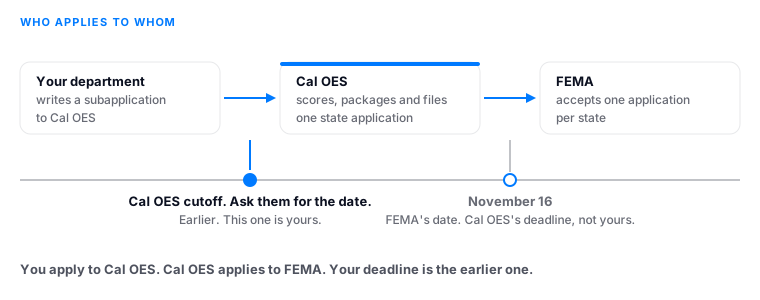
The Notice of Funding Opportunity (NOFO) is unambiguous: the State Administrative Agency is the only entity eligible to submit a C-UAS application to DHS/FEMA. In California, that is Cal OES. Your department does not apply to FEMA. You apply to Cal OES, which assembles a state application and submits it.
Which means the November 16 federal date was Cal OES's deadline, not yours. Cal OES had to collect subapplications, score them, build a state package and file it before that date, so its internal cutoff landed earlier. Other states published subapplication cutoffs ranging from early to late November. The lesson for the next federal notice: do not work backwards from the federal date. Call Cal OES and ask for theirs.
What the money is and what it buys
- $250 million, the second half of a $500 million program created under the Working Families Tax Cut Act, 2025 (Pub. L. No. 119-21, Sec. 90005(a)).
- Up to 56 awards, one per state and territory, with statutory minimums set under the State Homeland Security Grant Program and additional funds allocated on the DHS Terrorism Risk Methodology and the strength of proposed projects.
- No cost share. The NOFO states plainly that there is no cost share requirement, which removes the match problem that keeps small agencies out of other federal programs.
- A three-year runway. Anticipated selection December 2, 2026, award December 10, 2026, and a period of performance running to December 9, 2029.
Funds buy UAS Detection, Identification, Monitoring, Tracking and Mitigation technology, grouped into five cost categories: planning, organization, equipment, training and exercises. DHS specifically encourages radar, on the reasoning that radio-frequency detection depends on a drone emitting something, while radar sees aircraft that are autonomous, pre-programmed, stripped of Remote ID, or otherwise quiet.
The Olympic priority is the California angle
The notice asks that costs support National Special Security Events and Special Event Assessment Rating events, and then says so directly: prioritize C-UAS planning and capability that prepares for the 2028 Olympic and Paralympic Games, the Torch Relay, and ancillary events. The Los Angeles games are a designated National Special Security Event.
Read that as a California agency and the implication is not subtle. The torch relay is not a stadium problem. It is a moving event crossing dozens of jurisdictions, most of which are ordinary municipal departments that will be asked to secure a route for a day with whatever they have. An agency anywhere near that route, or near a training site, a team base, or an ancillary venue, has a defensible nexus to write about. So does any agency that expects mutual aid requests during the games.
Buying the equipment is not the same as being allowed to use it
The NOFO makes a distinction that is easy to miss and expensive to miss: the authority to purchase this equipment is not the same to operationally utilize the equipment.
Operating certain detection technology, and all mitigation technology, is limited to accredited law enforcement and correctional agencies that meet the training, certification, accreditation and authorized-technology requirements of Part 124 of Title 6 of the Code of Federal Regulations (6 C.F.R. Part 124), under the SAFER SKIES ACT (Pub. L. No. 119-60). A subrecipient that is not itself the designated operating agency has to execute a written agreement with one that is.
In practice: detection and tracking are the realistic ask for most departments. Mitigation, meaning actually defeating a drone, is a narrow authority and you should confirm where your agency stands before you build a budget around it.
Who can receive a subaward
Cal OES may subaward to state, local, tribal and territorial government entities, and the NOFO lists them: city and county agencies, law enforcement, correctional agencies, fire services, emergency medical services, emergency management, and other qualifying public safety organizations. Tribal governments cannot apply directly but participate as subrecipients through the State Administrative Agency (SAA). Regional and intergovernmental bodies are eligible for mitigation and restricted-detection subawards.
That list is broader than police. If your counter-drone problem is really a multi-agency problem, and at an Olympic torch relay it certainly is, a joint subapplication across police, fire and emergency management reads better than three competing ones.
What to do now that the window has closed
- Call Cal OES Grants and ask where your agency stands. If your project went into the state application, ask what happens between the federal award and your subaward. If it did not, ask whether the state's award leaves room for a project that was not in the package. Only Cal OES can answer either question.
- Find your nexus and write it down. Route proximity, venue proximity, critical infrastructure, mutual aid obligations, prior SEAR-designated events you have supported.
- Decide detection or mitigation early. The accreditation requirements under 6 C.F.R. 124 shape the whole budget, and getting this wrong late is how applications fall apart.
- Scope the coordination, not only the sensors. Planning, training and exercises are allowable categories. Budget for the people and the planning that turn a detection into a decision, not only the sensor.
FY2027 was the second half of the $500 million Congress set aside, and FEMA has not announced a further round. If one comes, the agencies ready for it will be the ones with the nexus, the authority question and the budget already on paper.
Where this sits next to the rest of the funding map
Current status and deadlines for every program are kept in one place: the grants hub. The other programs on that map, Byrne JAG (the Edward Byrne Memorial Justice Assistance Grant), FEMA's Homeland Security Grant Program, the DOJ Model Cities Initiative and the Office of Community Oriented Policing Services (COPS) Technology and Equipment Program, each run on their own calendar, and the COPS program funds only Congressionally designated projects. If you are building a drone program rather than a counter-drone capability, the DRONE Act route through Byrne JAG and COPS is the one to read next.
No. The NOFO states that the State Administrative Agency is the only entity eligible to submit a C-UAS application to DHS/FEMA. In California that is Cal OES. Local agencies participate as subrecipients, applying to Cal OES rather than to FEMA, and Cal OES issues subawards to city and county agencies, law enforcement, correctional agencies, fire services, EMS, emergency management and other qualifying public safety organizations.
The federal deadline for State Administrative Agencies to file with FEMA was November 16, 2026, and the round is closed. A local agency's deadline was whatever cutoff its SAA set for subapplications, which necessarily fell earlier because the SAA had to score submissions and assemble a state package first. California agencies with a question about subawards should contact Cal OES Grants directly.
No. The FY2027 NOFO states there is no cost share requirement and lists cost share description, type and restrictions as not applicable. That makes it unusually accessible for smaller agencies that are often priced out of federal programs by a match they cannot fund.
FEMA directs that costs support National Special Security Events and SEAR events, and names preparation for the 2028 Olympic and Paralympic Games, the Torch Relay and ancillary events as a priority. The Los Angeles games are a designated National Special Security Event. Agencies along the relay route, near venues or training sites, or likely to receive mutual aid requests during the games have a direct nexus to write about.
Yes. Allowable costs fall into five categories: planning, organization, equipment, training and exercises. Every cost must show a nexus to preventing, preparing for, protecting against or responding to acts of terrorism under 6 U.S.C. 609(a) and 605(a). DHS also encourages radar specifically, because radio-frequency detection depends on a drone emitting a signal while radar detects aircraft that are autonomous, pre-programmed or operating without Remote ID.
Planning, training and exercises are allowable C-UAS costs. If the live video from the event and the record of the operation need to reach command, mutual aid partners and the EOC rather than one screen, see how BabbarOps fits alongside the sensors you buy.
Download the one-page overview
Sukh Bhela is a California police sergeant who has served as a UAS operator, UAS supervisor, and incident commander during critical incidents. His experience leading patrol operations and integrating drone technology into public safety responses led him to found BabbarOps, where he builds tools for live situational awareness and incident command. He writes about policing, drone operations, leadership, and the technology shaping the future of emergency response.
Published in Police1 · Covered by Officer.com · Press
The views expressed here are the author's own, written in his personal capacity. They do not represent, and are not made on behalf of, any law enforcement agency or employer.
Grant programs, eligibility rules, deadlines and solicitations change, and subapplication deadlines are set by each State Administrative Agency rather than by FEMA. Verify every requirement against the current NOFO and with Cal OES before applying. This article is for general information and is not legal, financial or grant-writing advice.