
Byrne JAG: what it actually pays for, and how a California agency gets it
The Edward Byrne Memorial Justice Assistance Grant is a formula grant covering nine purpose areas, including law enforcement and planning, evaluation and technology improvement. It funds personnel, equipment, supplies, contractual support, training and information systems, and the statute now names programs to purchase and operate unmanned aircraft systems and counter-UAS systems outright. No match is required. Sixty percent of each state's allocation goes to the state and forty percent directly to eligible units of local government; in California the state share is administered by the Board of State and Community Corrections.
Byrne JAG, the Edward Byrne Memorial Justice Assistance Grant, is the least glamorous program on the federal funding map and the one most likely to actually pay for something you need. It is also widely misunderstood, because agencies treat it like a competition. It is not. It is a formula.
Check your own city’s number. BJA publishes each California city’s Byrne JAG allocation. Look up yours and get a draft application.
Nobody scores your narrative against other departments to decide whether you get money. The Bureau of Justice Statistics (BJS) calculates allocations from population and Part 1 violent crime data, and the money is already notionally yours. The question is whether you claim it and what you spend it on.
The nine purpose areas
JAG funds personnel, equipment, supplies, contractual support, training, technical assistance and information systems across nine areas:
- Law enforcement
- Prosecution and courts
- Prevention and education
- Corrections and community corrections
- Drug treatment and enforcement
- Planning, evaluation, and technology improvement
- Crime victim and witness programs, other than compensation
- Mental health programs and related law enforcement and corrections programs, including crisis intervention teams
- State crisis intervention court proceedings, including mental health, drug and veterans courts and extreme risk protection order programs
Two phrases in there do most of the work for a technology buy. Information systems is in the statute, which is why software is fundable rather than something you have to argue into an equipment line. And planning, evaluation, and technology improvement is a purpose area in its own right, not a footnote to one.
Drones and counter-drones are now named outright
This is the change most agencies have not caught up with. The Bureau of Justice Assistance (BJA) lists on its own program fact sheet, alongside the nine areas:
- Programs to purchase and operate unmanned aircraft systems (as defined in 49 U.S.C. § 44801) to benefit public safety.
- Programs to purchase and operate counter-UAS (C-UAS) systems on the technology list established under 6 U.S.C. § 124n(d)(2)(A)(iii).
You no longer have to reason your way from "equipment" to a drone. The statute says drone. That came from the DRONE Act, and it means JAG and the FY2027 Counter-UAS program can be worked as complementary rather than competing routes: C-UAS for the detection build, JAG for the sustainment, training and the systems that carry the picture.
No match, and a four-year runway
Two structural facts that matter more than they sound.
A match is not required. That single line removes the obstacle that keeps small departments out of most federal money, because there is no local share to find in a budget that was spent before the year started.
Awards of $25,000 or more carry a four-year period of performance, and awards under $25,000 carry two years, extendable to four on request. For anything with a recurring cost, that four-year window is the difference between buying a thing once and funding a capability long enough to prove it. Awards typically begin October 1.
How the money splits, and why some agencies get a check directly
Once BJS calculates a state's allocation, 60 percent goes to the state and 40 percent goes directly to eligible units of local government. Whether you are in that 40 percent is not a choice you make. It is determined by your jurisdiction's share of Part 1 violent crimes reported to the FBI over the three most recent years, and only units set to receive $10,000 or more qualify for a direct allocation.
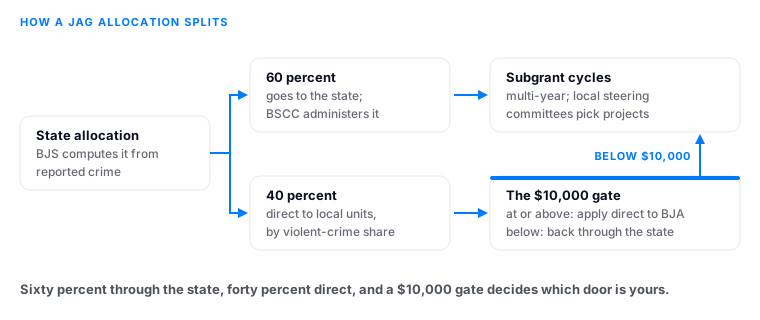
If your department clears that bar, you apply directly to BJA through Grants.gov and JustGrants. If it does not, your route is the state share, and in California that means the Board of State and Community Corrections (BSCC). BSCC is California's designated State Administering Agency for JAG, and it runs multi-year subgrant cycles with local steering committees guiding how subrecipients choose projects. BJA issues separate state and local JAG notices each year, generally in spring or summer.
Your crime reporting is your allocation
This is the part worth sitting with, because it is the one lever an agency actually controls.
JAG allocations are calculated from the violent crime data you report to the FBI's Uniform Crime Reporting (UCR) Program, through either the Summary Reporting System (SRS) or the National Incident-Based Reporting System (NIBRS). Agencies reporting through either are eligible. But the arithmetic differs: for NIBRS submissions, all offenses in an incident count toward the jurisdiction's violent crime total, while for SRS submissions only the most serious offense in an incident counts, under the hierarchy rule.
Read that again if your agency is still on SRS. The formula that sets your money is fed by the data you send, and the two reporting paths do not count the same way. Reporting quality is not an administrative chore here. It is the input to your allocation.
What can reduce your award
- SORNA. A state that has not substantially implemented the Sex Offender Registration and Notification Act takes a 10 percent reduction, applied for each year it falls short.
- PREA. If a governor does not certify compliance with the Prison Rape Elimination Act national standards, the state can lose 5 percent of certain DOJ funds, JAG included.
- DCRA. States must submit a Death in Custody Reporting Act implementation plan with their applications and report the data.
These are state-level penalties rather than things a city department controls, but they shape the size of the pot your subgrant comes out of.
What to do, and when
The FY2026 local round closed on November 20, 2026, after BJA extended the deadlines twice. The Grants.gov step closed two days earlier, on November 18. BJA generally posts the notices in spring or summer, though it posted the FY2026 local one on August 25, 2026. Either way the next round is months out, so the useful work now is positioning.
- Find out whether you are a direct allocation jurisdiction. BJA publishes allocation charts each year. If you are on them, you apply to BJA; if not, your conversation is with BSCC.
- Check your UCR reporting. Whether you submit through NIBRS or SRS changes how your violent crime count is calculated, and that count sets your allocation.
- Write the project before the notice drops. Formula money still needs a defensible project and a budget. Agencies that have one ready in March are not scrambling in June.
- Use the four years. Scope something that needs sustaining, not just a one-time purchase, because the period of performance supports it.
Where it sits in the funding map
JAG is the flexible workhorse: broad purpose areas, no match, predictable timing. It is rarely the biggest number available, and it is almost always the most usable. Current status and deadlines for every program are kept in one place: the grants hub. If you are standing up a drone program specifically, the DRONE Act route covers how JAG and the Office of Community Oriented Policing Services (COPS) fit together.
No. JAG is a formula grant. The Bureau of Justice Statistics calculates each state's allocation from a minimum base amount enhanced by the state's share of national population and its share of the country's Part 1 violent crimes as reported to the FBI's UCR Program. Agencies are not scored against each other for an award, though they still have to apply and justify a project and budget.
Yes, and the statute names both. BJA's program fact sheet lists programs to purchase and operate unmanned aircraft systems as defined in 49 U.S.C. 44801 to benefit public safety, and programs to purchase and operate counter-UAS systems included on the technology list established under 6 U.S.C. 124n(d)(2)(A)(iii). Agencies no longer have to argue a drone into a general equipment line.
No. BJA states plainly that a match is not required. That makes JAG unusually accessible for smaller agencies that cannot fund the local share many federal programs demand.
It depends on your allocation. Forty percent of California's total goes directly to eligible units of local government, and units set to receive $10,000 or more qualify for a direct award, applying to BJA through Grants.gov and JustGrants. The remaining 60 percent is administered by the Board of State and Community Corrections, California's designated State Administering Agency, which runs subgrant cycles for everyone else.
Awards of $25,000 or more have a four-year period of performance. Awards under $25,000 have two years, and extension requests on those are approved automatically up to four years. Awards typically begin on the first day of the federal fiscal year, October 1. The long runway makes JAG suited to capabilities with recurring costs rather than one-time purchases alone.
Yes. The authorizing language covers personnel, equipment, supplies, contractual support, training, technical assistance and information systems, and planning, evaluation and technology improvement is one of the nine purpose areas in its own right. Software and the systems around it are fundable without being argued into an equipment category.
Planning, evaluation and technology improvement is a JAG purpose area, and information systems are named in the statute. See how a flat-cost, hardware-agnostic live video and incident command layer fits a four-year period of performance.
Download the one-page overview
Sukh Bhela is a California police sergeant who has served as a UAS operator, UAS supervisor, and incident commander during critical incidents. His experience leading patrol operations and integrating drone technology into public safety responses led him to found BabbarOps, where he builds tools for live situational awareness and incident command. He writes about policing, drone operations, leadership, and the technology shaping the future of emergency response.
Published in Police1 · Covered by Officer.com · Press
The views expressed here are the author's own, written in his personal capacity. They do not represent, and are not made on behalf of, any law enforcement agency or employer.
Grant programs, eligibility rules, allocations and solicitations change, and state subgrant processes are set by each State Administering Agency rather than by BJA. Verify current requirements against the annual JAG notice, the BJA allocation charts and, in California, with BSCC before applying. This article is for general information and is not legal, financial or grant-writing advice.