
How to start a public safety drone program
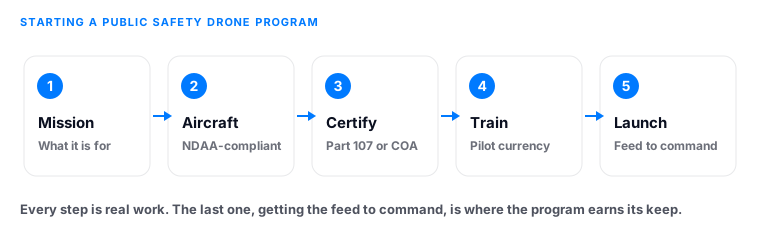
Standing up a UAS program is more than buying a drone. It’s aircraft, certification, training, airspace authority, and (the part agencies forget) getting the live feed to the people making decisions. Here’s the practical path.
A public safety drone program can change how an agency handles everything from active calls to search operations to crash reconstruction. But the agencies that succeed treat it as a program, not a purchase. The aircraft is the easy part. The structure around it (certification, training, regulatory authority, and operational integration) is what makes it last. Here’s how the pieces fit.
1. Define the mission first
Before any hardware, decide what the program is for. The mission drives every other call: aircraft, training, and authority all follow from it. Common public-safety use cases:
- Tactical / SWAT support: overwatch, perimeter, and situational awareness on high-risk operations.
- Search and rescue: covering ground fast, often with thermal imaging.
- Crime and crash scene documentation: rapid, accurate mapping.
- Drone as first responder (DFR): launching on calls to get eyes overhead before units arrive.
A documentation-only program and a DFR program look nothing alike in aircraft, staffing, and regulatory needs. Decide the mission, then build to it.
2. Choosing aircraft: criteria over brand
Don’t chase a specific model. The market moves fast, and procurement and security considerations vary by agency. Evaluate aircraft against your mission instead:
- Sensors: does the mission need thermal/IR, optical zoom, or mapping payloads?
- Flight time and range: enough endurance for your typical call?
- Reliability and support: serviceability, parts, and vendor longevity.
- Security and procurement compliance: confirm the platform meets your agency’s and state’s data-security and procurement requirements.
- Streaming capability: can it get a live feed off the aircraft to command? (More on this below.)
Buy for the mission you defined in step one, with room to grow into the next.
3. Certification: Part 107 and the COA path
Public-safety agencies in the U.S. generally operate under one of two regulatory frameworks, and many use both:
Part 107
The FAA’s small-UAS rule. Pilots earn a Remote Pilot Certificate by passing the FAA aeronautical knowledge exam. It’s the most common starting point and covers a broad range of operations.
Certificate of Waiver or Authorization (COA)
A public agency can apply to the FAA for a COA, which can authorize operations tailored to public-safety needs that go beyond standard Part 107 limits. Many agencies run a hybrid: Part 107-certified pilots, plus a COA for specific expanded operations.
4. Training: initial and continued
Certification is the floor, not the ceiling. A real program builds proficiency and keeps it:
- Initial training: airmanship, agency policy, and mission-specific skills beyond the FAA written exam.
- Continued / recurrent training: regular flight proficiency, scenario work, and staying current as pilots and policy evolve.
- Currency standards: minimum flight hours and recurring evaluations so skills don’t decay between callouts.
The agencies that get the most out of UAS treat training as ongoing, not a one-time event.
5. Expanded operations: night flights and airspace
Two areas come up constantly as a program matures:
Night operations
Night flying has specific FAA requirements around pilot training and aircraft lighting. A lot of the most valuable public-safety missions happen after dark, so plan for night-capable operations, and confirm the current FAA requirements before you fly them.
Controlled airspace and airports
Operating near airports or in controlled airspace requires authorization. The FAA’s LAANC system provides near-real-time authorization in many controlled areas, and additional waivers or COA provisions may apply. Map your jurisdiction’s airspace early. It shapes where and how you can operate.
6. The step most programs underestimate: getting the feed to command
Here’s the gap that turns a good drone program into an underused one. You can buy excellent aircraft, certify pilots, and earn your authorizations, and still have the live video stuck with the pilot, never reaching the commander forming the plan or the units rolling up.
A drone’s value is the view it gives the people making decisions. If that view never leaves the aircraft, you built a flight program, not a situational-awareness program. Plan from day one for how the feed reaches command: live, and on the same picture as your other assets.
7. Funding the program
Cost is the first question command staff asks. A sustainable program usually combines more than one source:
- Agency budget. The baseline, but be ready to show the return: faster clearances, fewer units tied up, less reliance on crewed aircraft.
- Grants. Federal and state public-safety technology grants frequently cover UAS. Build the proposal around outcomes, not gear.
- Community and local funding. Some programs supplement with local business support or community fundraising, paired with transparency about how drones are used.
Whatever the source, the total cost is more than the airframe: factor in training, maintenance, replacement batteries and parts, software, and the recurring fees some platforms charge per device. A program priced only on the drone is underpriced. See our breakdown of the real cost of a drone program for the full picture.
8. Community trust, policy, and transparency
The fastest way to lose a drone program is to lose the public’s confidence in it. The agencies that keep community support do a few things consistently:
- Written policy, published. A clear directive on when and why drones deploy, posted publicly so residents can read it themselves.
- Privacy guardrails. Explicit limits on recording where people have a reasonable expectation of privacy, consistent with the Fourth Amendment and your state’s law.
- Transparency. Many programs publish flight logs or annual deployment data. Openness up front prevents distrust later.
- A named program manager. One accountable owner for policy, compliance, and review.
Treat community trust as program infrastructure, not public relations. It’s what carries the program through its first controversy.
Where BabbarOps fits
BabbarOps is the live command layer for the program you just built. It’s hardware-agnostic, so it works with whatever aircraft you chose: one tap to go live, one login for everyone who needs to watch. As the program adds aircraft, sensors, and missions, the platform grows with it: no per-device license fees, no re-platforming. You build the drone program. BabbarOps makes sure the feed gets where it matters.
More than an aircraft. A durable program starts by defining the mission, then builds the structure around it: aircraft chosen against that mission, pilot certification under Part 107 or a COA, initial and recurrent training, airspace planning, and a plan for getting the live feed to the people making decisions.
Part 107 is the most common starting point: pilots earn a Remote Pilot Certificate by passing the FAA aeronautical knowledge exam. A public agency can also apply for a Certificate of Waiver or Authorization (COA) for operations beyond standard Part 107 limits. Most successful programs run a hybrid: Part 107-certified pilots with a COA for the operations the mission requires.
The total cost is more than the airframe. Factor in training, maintenance, replacement batteries and parts, software, and the recurring fees some platforms charge per device. Sustainable programs usually combine more than one funding source: agency budget, federal and state grants, and sometimes community or local funding.
Plan for it from day one, because a drone's value is the view it gives the people making decisions. If the feed stays with the pilot, you've built a flight program, not a situational-awareness program. BabbarOps is a hardware-agnostic live command layer that works with whatever aircraft you choose, with one login for everyone who needs to watch and no per-device license fees.

Sukh Bhela is a California police sergeant who has served as a UAS operator, UAS supervisor, and incident commander during critical incidents. His experience leading patrol operations and integrating drone technology into public safety responses led him to found BabbarOps, where he builds tools for live situational awareness and incident command. He writes about policing, drone operations, leadership, and the technology shaping the future of emergency response.
The views expressed here are the author's own, written in his personal capacity. They do not represent, and are not made on behalf of, any law enforcement agency or employer.
This guide is general information, not legal or regulatory advice. FAA rules for Part 107, COAs, night operations, and airspace authorization change over time and vary by situation; always confirm current requirements directly with the FAA and your agency’s legal authority before operating. BabbarOps is an independent commercial product and is not affiliated with or endorsed by any law enforcement agency or the FAA.