
What Is Situational Awareness in Public Safety?
Situational awareness is knowing what’s happening, understanding what it means, and anticipating what comes next in time to act. In public safety it’s the difference between running an incident and reacting to it. Here’s the part most people miss: at scale, situational awareness is an organization problem, not a feeds problem. More cameras don’t create it. It takes structure, and a decision maker who’s free to focus on problem solving while everything else is handled.
Think about an at-risk missing person, an elderly subject who wandered off, and the inputs are pouring in. Callers are phoning the location into Dispatch, units are checking the parks and the creek line, a drone is up scanning the open ground, and a camera near the corner store catches someone matching the description. None of it is short on information. The trouble is that nobody is turning all of it into one understanding, and an hour in, two separate reports describe the same person walking the same direction and nobody connects them. That is the lesson under all of this: perceiving the inputs is the easy part. Comprehending what they add up to is the hard part, and it is where the search is won or lost.
What are the three levels of situational awareness?
The widely used model, formalized by Endsley (1995), breaks situational awareness into three levels. Each maps cleanly onto a real incident:
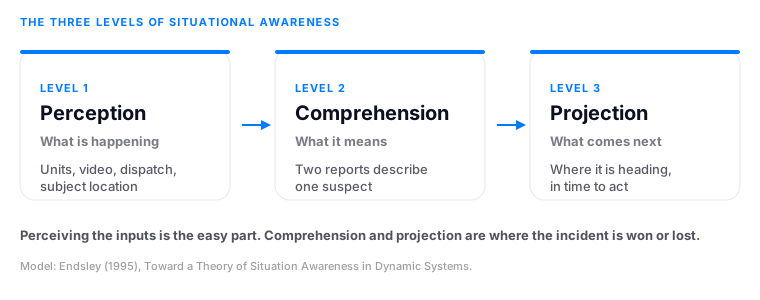
1. Perception, what is happening
The raw inputs: where units are, what the video shows, what dispatch is reporting, where the subject is. If you can’t perceive it, you can’t act on it.
2. Comprehension, what it means
Turning inputs into understanding: this is a containment problem, that intel changes the risk picture, those two reports describe the same person.
3. Projection, what happens next
Anticipating the next move: if the subject exits the rear, who covers it; if this escalates, what the tactical plan needs to be. This is where experienced commanders live. Good information makes them faster.
How does situational awareness work in practice during a major incident?
Early in a major incident the problem isn’t too little information, it’s too much of it at once. The radio has a ton of traffic, reports come in faster than anyone can sort them, every unit that can respond is saying so, and the scene keeps changing while decisions are still being made about the version of it from two minutes ago. The chaos becomes anxiety you can feel.
A good Incident Commander brings organization, calm, and focus to that. The first five minutes is getting control of the scene: containment, a point person with firsthand information, and a react team ready to act. You slow the scene down. Then you build it up: intel, communications, staging, EMS, and escape routes. While they do it, they’re carrying several jobs at once:
- Organizing the resources they have, knowing what’s on scene and putting it where it’s needed.
- Predicting the resources they’ll need, calling for the next units, teams, and support before the gap becomes a crisis.
- Assessing risk continuously, to officers, to the public, to the subject, as the picture shifts.
- Problem solving in real time, adapting the plan as new information lands.
All of that competes for the same attention. Every minute spent hunting for information, chasing an update, reconciling two reports, asking who’s where, is a minute not spent on risk and decisions. The job of good situational awareness tooling is to take the organizing burden off the commander so their attention goes to the part only they can do: read the threat and solve the problem.
Why does situational awareness break down during an incident?
The failure usually isn’t a lack of information, it’s that the information is fragmented. On a growing incident:
- Video lives in one system, sometimes only in the aircraft or with one pilot.
- Assignments live on a whiteboard at the command post.
- Intel is scattered across CAD comments, texts, notebooks, and verbal updates.
- Investigators, patrol, and tactical teams each hold a different slice.
Every one of those tools works. They just don’t work together, so no single person ever holds the whole incident, and the unified view they do assemble is already behind it.
What does real situational awareness require?
Achieving it on a live call, not just talking about it, takes three things:
- Every source in one place. Live video and the incident plan together, not on separate screens.
- Live sync. The moment the picture changes, everyone sees the change. No briefing lag.
- Every role, one view. Patrol, command, tactical, investigations, and leadership all working from the same current information.
That combination is what turns scattered inputs into a shared operational picture, the practical form situational awareness takes in the field, and the basis of the common operating picture that FEMA’s National Incident Management System (NIMS) calls for when multiple roles and agencies respond together. The picture is the tool; the awareness is what commanders act on.
How does situational awareness tooling fit with incident command?
Situational awareness and incident command are two sides of the same operation. Awareness tells you what’s happening; incident command software is the workspace where you act on it, tracking resources, assignments, perimeter, and intel in one live synced view. BabbarOps puts both on the same platform: every feed, drones, aircraft, cameras, witness phones, on one wall, paired with a live synced workspace that everyone with a need to know works from. The shared view also means the IC isn’t the one relaying every update.
That is the real test of situational awareness at scale. Not how many cameras you can put up, but whether the person making the call can stop hunting for information long enough to read the threat and solve the problem. Give them that, and the awareness takes care of itself.
Situational awareness is the ability to know what is happening around you, understand what it means, and anticipate what comes next, in time to act on it. In public safety, it is the difference between running an incident and merely reacting to it.
The Endsley model defines three levels: (1) Perception, the raw inputs, what is actually happening; (2) Comprehension, what those inputs mean together; and (3) Projection, anticipating what happens next in time to act. Each level depends on the one before it.
The failure is almost never a lack of information, it’s that the information is fragmented. Video in one system, assignments on a whiteboard, intel across texts and notebooks. Each tool works in isolation, but no one holds the whole picture, and the version they assemble is already behind the incident.
Situational awareness is the cognitive state, knowing what’s happening, what it means, and what comes next. A common operating picture is the practical tool that enables it: a single, shared, live view every role works from. The picture supports the awareness; the awareness is what commanders act on.
Real situational awareness requires every source in one place (live video alongside the incident plan), live sync so the moment the picture changes everyone sees it, and a single view every role works from. Platforms that combine live video feeds with a shared incident command workspace come closest to delivering this in practice.
The Endsley model, developed by researcher Mica Endsley, defines situational awareness as three sequential levels: perception of elements in the environment, comprehension of their meaning, and projection of their future status. It is widely applied in aviation, military operations, and public safety command.
Sources: Endsley, M.R. (1995). Toward a Theory of Situation Awareness in Dynamic Systems. Human Factors, 37(1), 32–64.; FEMA, National Incident Management System (NIMS).
You have radios and cameras, but that doesn’t give everyone responding a shared picture. BabbarOps does: drones, aircraft, cameras, and witness video on one wall, paired with a live synced incident command workspace. See it working with your assets.

Sukh Bhela is a California police sergeant who has served as a UAS operator, UAS supervisor, and incident commander during critical incidents. His experience leading patrol operations and integrating drone technology into public safety responses led him to found BabbarOps, where he builds tools for live situational awareness and incident command. He writes about policing, drone operations, leadership, and the technology shaping the future of emergency response.
The views expressed here are the author's own, written in his personal capacity. They do not represent, and are not made on behalf of, any law enforcement agency or employer.
BabbarOps is an independent commercial product and is not affiliated with or endorsed by any law enforcement agency.