
Real-time crime center vs. live incident command: where each fits
They’re often lumped together, but they answer different questions. Understanding the difference helps an agency see what it actually has, and what it’s missing.
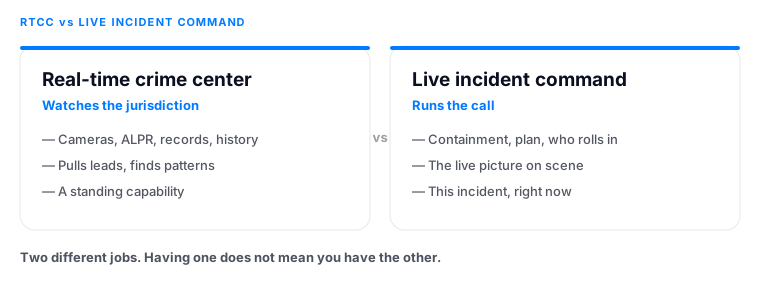
It’s 0200 and an in-progress call goes bad. In the crime center, an analyst is watching the whole jurisdiction, pulling history and camera hits and feeding leads to the units. Out on the street, the patrol supervisor is the one actually running this call: forming a plan, sorting who is rolling up, deciding what happens next. Two different jobs at the same moment, and neither one does the other’s work. As agencies invest in situational awareness, the two get blurred: the real-time crime center (RTCC) and a live incident command layer both deal with information and video, but they sit at different points in an operation, and having one doesn’t mean you have the other.
What an RTCC does well
A real-time crime center is typically a fixed, centralized capability: a room and a team that aggregate cameras, data feeds, and analytics to support investigations and monitor ongoing activity across a jurisdiction, the mission the U.S. DOJ Bureau of Justice Assistance outlines for a Real-Time Crime Center. Its strengths are breadth, persistence, and analysis over time.
What live incident command does well
A live incident command layer is about one specific incident, right now. It puts the standardized command structure of the Incident Command System, the model codified in FEMA’s National Incident Management System, to work on a single call, pulling the feeds and the plan for that call into a single shared picture that the people working the incident, in the field and at command, act from in real time.
- Scope: the active incident, not the whole jurisdiction.
- Users: the responders and command running the call.
- Job: change the outcome during the incident.
Why agencies need the incident layer too
The RTCC may not be staffed at 0200, and it isn’t built to put the current picture into the hands of the unit rolling up or the supervisor forming a plan on scene. That’s the gap BabbarOps fills: every feed on one wall, a live-synced command workspace, and one login for everyone with a need to know, available the moment the incident starts, wherever the responders are.
The two are complementary, and most agencies have invested in some form of the first and have nothing purpose-built for the second. The RTCC keeps watching the jurisdiction. But at 0200, with the call going bad, the question isn’t who is watching. It’s who is running it, and whether everyone on the call can see what the supervisor sees.
A real-time crime center is a fixed, centralized capability: a room and a team that aggregate cameras, data feeds, and analytics to support investigations and monitor activity across a jurisdiction. A live incident command layer is about one specific incident, right now: it pulls the feeds and the plan for that call into a single shared picture for the people working it. In short, an RTCC watches the jurisdiction while live incident command runs the call.
An RTCC may not be staffed at 0200 when a call goes bad, and it isn't designed to put the live picture into the hands of the unit rolling up or the supervisor forming a plan on scene. Its strengths are breadth, persistence, and analysis over time, not running the active call. That gap is what a live incident command layer fills.
No. The two are complementary: the RTCC supports the long view, and the live incident command layer runs the incident itself. Most agencies have invested in some form of the first and have nothing purpose-built for the second.
The responders and command actually running the call, in the field and at command. The scope is the active incident rather than the whole jurisdiction, and the job is to change the outcome during the incident. Everyone with a need to know works from one live picture, available the moment the incident starts.
Sources: U.S. DOJ Bureau of Justice Assistance, The Mission of a Real-Time Crime Center; FEMA, National Incident Management System (NIMS); FEMA, National Incident Management System, 3rd ed. (2017).

Sukh Bhela is a California police sergeant who has served as a UAS operator, UAS supervisor, and incident commander during critical incidents. His experience leading patrol operations and integrating drone technology into public safety responses led him to found BabbarOps, where he builds tools for live situational awareness and incident command. He writes about policing, drone operations, leadership, and the technology shaping the future of emergency response.
The views expressed here are the author's own, written in his personal capacity. They do not represent, and are not made on behalf of, any law enforcement agency or employer.
BabbarOps is an independent commercial product and is not affiliated with or endorsed by any law enforcement agency. This article describes categories generally and does not reference any specific product.