
What is a Real-Time Crime Center (RTCC)?
An RTCC pulls an agency’s cameras, data, and intelligence into one room so analysts can support officers in real time. It does that job well, and understanding what it does (and doesn’t) tells you exactly where the gaps still are.
“Real-Time Crime Center” is one of the few technology terms everyone in an agency recognizes, from the chief to the city manager. But what an RTCC actually is varies a lot between departments, and the term gets used loosely. Here’s the plain version.
The definition
A Real-Time Crime Center (RTCC) is a centralized hub, usually a physical room staffed by analysts, that aggregates information from across an agency and pushes it to officers and investigators in real time. As the U.S. DOJ Bureau of Justice Assistance describes the mission of a Real-Time Crime Center, the goal is to put more eyes and more data behind the people in the field.
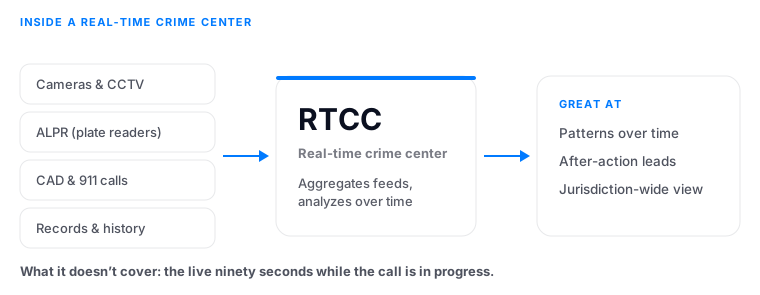
What an RTCC typically aggregates
- Camera networks: fixed city cameras, business and residential feeds registered to the agency, sometimes traffic cameras.
- CAD: computer-aided dispatch, so analysts see calls as they come in.
- ALPR: automated license plate reader hits.
- Records and intelligence: RMS, warrants, prior contacts, and analytical tools.
- Increasingly, drone and DFR feeds: aerial video routed into the center.
Analysts fuse those sources to answer questions for officers on a call: who lives there, what’s the history, is there a camera nearby, where did the vehicle go.
What an RTCC is great at
- Intelligence depth. Pulling records, history, and context faster than a field unit ever could.
- Persistent coverage. Watching camera networks and data feeds across the whole jurisdiction, the operational picture over time.
- Investigative support. Connecting incidents, vehicles, and people over time.
Take a string of after-hours commercial burglaries that nobody connected at first: a smashed door here, a grab-and-run at a strip mall there, spread across a few weeks and a few beats. An analyst sitting on the camera networks and the license plate reader hits starts working backward, and the same partial plate keeps surfacing near each hit, a few minutes before or after. Pull the registered owner, tie in the prior contacts, and the scattered reports turn into one vehicle and one pattern. That is an RTCC at its best: the after-action and the pattern, the work no field unit has time to do mid-shift. What it doesn’t tell you is what to do in the ninety seconds while that vehicle is in front of an officer right now.
The gap an RTCC doesn’t fully close
Here’s the honest part. An RTCC is excellent at aggregating and supporting from a distance. But during a live, fast-moving incident, the people actually running the call under the Incident Command System defined by FEMA’s National Incident Management System (the on-scene commander, the SWAT element, the units rolling up) still struggle with one specific thing: getting every responder looking at the same live picture at the same time.
The RTCC may have the feeds. But the analyst is in a room, the commander is on scene, SWAT is staging, and information moves between them the only way it can: over the radio and the phone, relayed, fragmented, already a few minutes old by the time it lands. The aggregation problem is solved. The shared live picture at the point of action often isn’t.
Where BabbarOps fits
BabbarOps isn’t an RTCC and doesn’t replace one. It’s the live operational layer for the moment the incident is actually happening: every feed (drones, aircraft, fixed cameras, witness phones) on one wall, plus a live-synced incident workspace, so the commander, SWAT, investigators, and leadership all work from the same current picture.
If you have an RTCC, BabbarOps complements it: the center keeps doing the aggregation and intelligence work it’s built for, while the live workspace makes sure the current picture reaches everyone on the call. If you don’t have an RTCC, it gives you real-time shared awareness during incidents without standing up a full center.
An RTCC answers who, what, and where it went. During the call, the question is narrower and louder: what do we do in the next ninety seconds, and is everyone on the same page when we do it. Those are two different jobs, and a department that has solved the first still has to solve the second.
An RTCC is a centralized hub, usually a physical room staffed by analysts, that aggregates information from across an agency and pushes it to officers and investigators in real time. The goal is to put more eyes and more data behind the people in the field, answering questions like who lives there, what's the history, and where the vehicle went.
Typically camera networks (fixed city cameras and registered business or residential feeds), computer-aided dispatch, ALPR hits, and records and intelligence systems like RMS, warrants, and prior contacts. Increasingly, drone and DFR feeds are routed into the center as well.
An RTCC is excellent at aggregating and supporting from a distance, but during a live, fast-moving incident the people running the call still frequently struggle to get every responder looking at the same live picture at the same time. The analyst is in a room, the commander is on scene, and information moves between them over radio and phone: relayed, fragmented, and already a few minutes old when it lands.
No. If you have an RTCC, a live operational layer like BabbarOps complements it: the center keeps doing the aggregation and intelligence work it's built for. If you don't have an RTCC, BabbarOps gives you real-time shared awareness during incidents without standing up a full center.
Sources: U.S. DOJ Bureau of Justice Assistance, The Mission of a Real-Time Crime Center; FEMA, National Incident Management System (NIMS).

Sukh Bhela is a California police sergeant who has served as a UAS operator, UAS supervisor, and incident commander during critical incidents. His experience leading patrol operations and integrating drone technology into public safety responses led him to found BabbarOps, where he builds tools for live situational awareness and incident command. He writes about policing, drone operations, leadership, and the technology shaping the future of emergency response.
The views expressed here are the author's own, written in his personal capacity. They do not represent, and are not made on behalf of, any law enforcement agency or employer.
BabbarOps is an independent commercial product and is not affiliated with, endorsed by, or operated on behalf of any law enforcement agency. RTCC capabilities described here are general and vary by agency.