
Common Operating Picture (COP): what it means in public safety
Borrowed from the military and emergency management, a Common Operating Picture is the idea that everyone responding to an incident should be working from the same shared view. Simple in theory. Hard to actually achieve on a live call.
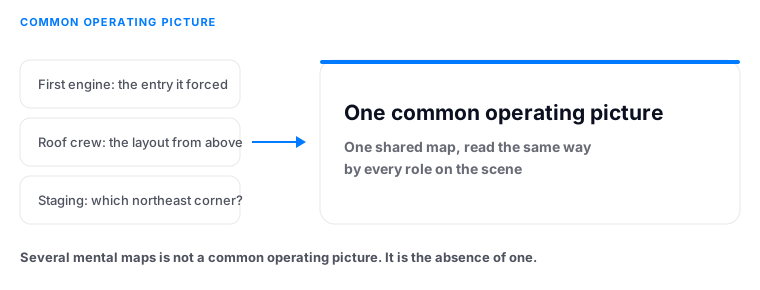
A working structure fire pulls in a dozen units fast, and within minutes every role is carrying a different map of the same building in their head. The first engine knows the entry it forced. The crew on the roof knows the layout from above. Somebody heard there were people on the second floor; somebody else heard the building was clear. Then two units stage on what they each call the northeast corner, and it turns out they mean opposite ends of the structure. Nobody lied and nobody froze. They just never had one shared map, and on a scene that big, several mental maps is not the same as a Common Operating Picture, it is the absence of one.
If you’ve worked in emergency management or come from a military background, you know the term Common Operating Picture, often shortened to COP, and sometimes written “Common Operational Picture.”
The definition
A Common Operating Picture is a single, shared display of a situation that all participating roles and agencies work from: the same information, available to everyone who needs it, at the same time. The goal is alignment: decisions made against one version of reality instead of several conflicting ones. This is the sense in which the term is formally defined in the FEMA NIMS doctrine (3rd ed., 2017).
Where the term comes from
COP originated in military command-and-control and was adopted into emergency management and incident command frameworks, including FEMA’s National Incident Management System (NIMS) and ICS. In those settings it usually means a shared map and data view (unit positions, hazards, resources, and objectives) maintained so that commanders, agencies, and supporting elements share situational awareness.
Why it’s hard to achieve on a live incident
The concept is sound. The execution is where it falls apart. On a real call, information arrives fragmented: video lives in one system, assignments on a whiteboard, intel in radio traffic and texts. Patrol has one view, SWAT another, investigations a third, leadership a fourth. The “common” part, the thing that makes a COP worth anything, is exactly what’s missing, because no single tool is holding one live workspace for everyone at once. So it gets held together by voice, over the radio, which is slow and drops pieces.
Common Operating Picture vs. shared operational picture
You’ll see both terms. They point at the same goal. We tend to say shared operational picture because it emphasizes the part that matters operationally: not just a common display, but a picture that’s genuinely shared: live-synced, current for every role, and reaching the people actually running the call, not just a command room. The word matters less than whether the picture is real-time and reaches everyone.
How BabbarOps makes the COP real
BabbarOps exists to turn the COP from a concept into something that actually holds during an incident: every live feed on one wall, plus a live-synced incident workspace where assignments, perimeter, resources, and intel stay current for every role. Patrol builds the picture, and SWAT, investigations, and leadership inherit it: the same picture, at the same time, without relaying it by radio. It is a common operating picture you can use while the call is still live, not one reconstructed afterward.
That is the whole point of the term, and it is easy to lose. A COP isn’t a screen in a command room or a map nobody on scene can see. It is one shared map, not several, and the test is brutally simple: when two units say the same corner, are they standing in the same place? If the answer depends on who you ask, you don’t have a common operating picture yet.
A Common Operating Picture is a single, shared display of a situation that all participating roles and agencies work from: the same information, available to everyone who needs it, at the same time. The goal is alignment: decisions made against one version of reality instead of several conflicting ones.
COP originated in military command-and-control and was adopted into emergency management and incident command frameworks, including NIMS/ICS. In those settings it usually means a shared map and data view (unit positions, hazards, resources, and objectives) maintained so commanders and supporting agencies share situational awareness.
They point at the same goal. "Shared operational picture" emphasizes the part that matters operationally: a picture that is live-synced, current for every role, and reaching the people actually running the call, not just a command room. The word matters less than whether the picture is real-time and reaches everyone.
BabbarOps puts every live feed on one wall, alongside a live-synced incident workspace where assignments, perimeter, resources, and intel stay current for every role. Patrol builds the picture, and SWAT, investigations, and leadership inherit it at the same time, without relaying it by radio.
Sources: FEMA, National Incident Management System (NIMS).; FEMA, NIMS Components and Guidance.; FEMA, National Incident Management System, 3rd ed. (2017).
Our founder made the operational case for this in Police1: a drone overhead is only worth what the people on the ground do with the picture, and that plan has to exist before launch. Why every drone deployment needs a communications plan →

Sukh Bhela is a California police sergeant who has served as a UAS operator, UAS supervisor, and incident commander during critical incidents. His experience leading patrol operations and integrating drone technology into public safety responses led him to found BabbarOps, where he builds tools for live situational awareness and incident command. He writes about policing, drone operations, leadership, and the technology shaping the future of emergency response.
The views expressed here are the author's own, written in his personal capacity. They do not represent, and are not made on behalf of, any law enforcement agency or employer.
BabbarOps is an independent commercial product and is not affiliated with, endorsed by, or operated on behalf of any law enforcement agency or the U.S. military.