
Who actually gives you the money: California's state administering agencies
Most federal public safety grants reach a California agency as a subaward from the state, not as a direct award from Washington. Which state body depends on where the money originates: the Board of State and Community Corrections administers Byrne JAG, SCIP and RSAT from DOJ; the Governor's Office of Emergency Services is the State Administrative Agency for FEMA homeland security programs including HSGP, UASI, SHSP and Counter-UAS, and also handles Coverdell and OVC victim assistance; the Victim Compensation Board handles victim compensation. Because the state assembles and files the federal application, its subapplication deadline always falls before the federal one.
Read almost any federal public safety grant notice and you eventually hit a sentence that stops a local agency cold: applications may only be submitted by the State Administrative Agency. FEMA's FY2027 Counter-UAS notice puts it bluntly, and the same structure governs homeland security money generally and most DOJ formula money.
Check your own city’s number. BJA publishes each California city’s Byrne JAG allocation. Look up yours and get a draft application.
It means the grant you are reading about is not one you apply for. Your state applies, and you apply to your state. Nobody explains this well, so agencies routinely calendar the federal deadline, start work three weeks out, and discover their actual window closed a fortnight ago.
The acronym collides
Part of the confusion is that two different federal departments use the same three letters for different things.
- DOJ says State Administering Agency. Each state designates one body authorized to apply on its behalf for Office of Justice Programs money.
- DHS and FEMA say State Administrative Agency. Same acronym, different designation, covering preparedness and homeland security grants.
In some states these are the same office. In California they are not, and neither is a single agency.
Who handles what in California
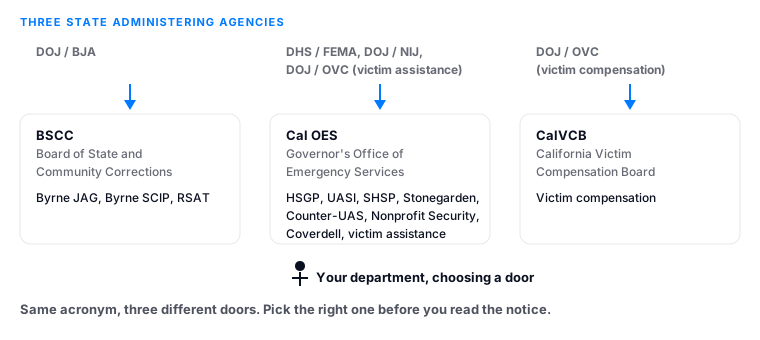
| Money comes from | Programs | Who you talk to |
|---|---|---|
| DOJ / Bureau of Justice Assistance (BJA) | Edward Byrne Memorial Justice Assistance Grant (JAG), Byrne State Crisis Intervention Program, Residential Substance Abuse Treatment | Board of State and Community Corrections (BSCC) |
| DHS / FEMA | Homeland Security Grant Program, Urban Area Security Initiative (UASI), State Homeland Security Program (SHSP), Operation Stonegarden, Nonprofit Security, Counter-UAS | Governor's Office of Emergency Services (Cal OES) |
| DOJ / NIJ | Paul Coverdell Forensic Science Improvement | Cal OES |
| DOJ / OVC | Victim assistance | Cal OES |
| DOJ / OVC | Victim compensation | California Victim Compensation Board |
So a department chasing drone money through Byrne JAG and counter-drone money through the FY2027 counter-UAS (C-UAS) round is dealing with two entirely separate state agencies, two separate processes and two separate calendars, for two programs that sit a paragraph apart on any funding list.
Why the state's deadline always comes first
The state is not a mailbox. It has to collect subapplications, score them against its own criteria, decide an allocation, assemble a single state package and file it federally. All of that happens before the date printed in the federal notice.
How much earlier is not published in the federal notice, because it is not FEMA's or BJA's decision. It varies by state and by program. For the FY2027 C-UAS round, states published their own subapplication cutoffs, and they varied by weeks. The only reliable way to know yours is to ask the state agency directly.
The practical rule: when you read a federal deadline, treat it as the last possible date your state can act, and assume yours is weeks earlier until someone tells you otherwise.
Being a subrecipient changes the rules you live under
A subaward is not a smaller version of a direct award. It carries both layers of requirement.
- Federal rules still apply. Procurement standards, allowable costs, reporting and audit obligations under Part 200 of Title 2 of the Code of Federal Regulations (2 C.F.R. Part 200) follow the money down.
- State rules apply on top. The administering agency sets its own application format, scoring, match expectations where it chooses to impose them, reporting cadence and invoicing process. These are frequently stricter than the federal baseline.
- Your relationship is with the state. If something goes wrong on reporting or spend-down, you answer to BSCC or Cal OES, not to Washington.
- Eligibility can narrow. A state may restrict a program to certain regions, agency types or project categories within what the federal notice allows. The federal notice tells you the ceiling, not your actual eligibility.
What this means for planning
- Identify your administering agency before you read the notice closely. It determines who you build a relationship with, and that relationship is worth more over time than any single application.
- Get on the notification list. Both BSCC and Cal OES publish solicitations and announcements. Subscribing costs nothing and is the difference between six weeks of lead time and six days.
- Ask for the subapplication deadline the moment a federal notice drops. Not the federal date. Theirs.
- Ask what the state adds. Scoring criteria, regional priorities and required attachments are state decisions and are usually where applications are actually won or lost.
- Expect the money to arrive on reimbursement. Most subawards pay against invoices for costs already incurred, which is a cash-flow question your finance office needs in the conversation early.
The exception worth knowing
Not everything is a subaward. Byrne JAG splits 60 percent to the state and 40 percent directly to eligible units of local government, with units set to receive $10,000 or more qualifying for a direct allocation and applying straight to BJA. Some FEMA programs, like Assistance to Firefighters, also take applications directly from fire departments and EMS.
So the first question on any program is not what it funds. It is who applies. Get that wrong and the rest of your preparation is aimed at the wrong door and the wrong calendar.
Current status and deadlines for every program are kept in one place: the grants hub.
There is no single one. DOJ's own listing shows the Board of State and Community Corrections administering Byrne JAG, the Byrne State Crisis Intervention Program and Residential Substance Abuse Treatment, while the Governor's Office of Emergency Services handles Paul Coverdell forensic science and OVC victim assistance, and the California Victim Compensation Board handles victim compensation. Separately, FEMA lists Cal OES as California's State Administrative Agency for homeland security programs.
They are different designations that share an acronym. DOJ uses State Administering Agency for the body authorized to apply for Office of Justice Programs funding on a state's behalf. DHS and FEMA use State Administrative Agency for preparedness and homeland security grants. In some states one office does both. In California they are different agencies, which is why the acronym causes so much trouble.
Because the state, not your department, files the federal application. The administering agency has to collect subapplications, score them, decide allocations and assemble one state package before the federal date. That work has to finish first, so the subapplication cutoff is always earlier. The federal notice does not publish it, because it is a state decision.
Sometimes. Byrne JAG awards 40 percent of each state's allocation directly to eligible units of local government, and units set to receive $10,000 or more apply straight to BJA through Grants.gov and JustGrants. FEMA's Assistance to Firefighters Grant also takes direct applications from fire departments and EMS. But for homeland security programs including Counter-UAS, HSGP, UASI and SHSP, only the State Administrative Agency may apply.
It comes with more. Federal requirements on procurement, allowable costs, reporting and audit under 2 C.F.R. Part 200 follow the money to the subrecipient, and the state layers its own application format, scoring, reporting cadence and invoicing on top. States may also narrow eligibility within what the federal notice permits, so the federal notice describes the ceiling rather than your actual eligibility.
Subawards reimburse against costs you have already incurred, so predictable pricing matters more than a headline discount. See how a flat-cost, hardware-agnostic platform fits a grant budget you have to defend to a state administering agency.
Download the one-page overview
Sukh Bhela is a California police sergeant who has served as a UAS operator, UAS supervisor, and incident commander during critical incidents. His experience leading patrol operations and integrating drone technology into public safety responses led him to found BabbarOps, where he builds tools for live situational awareness and incident command. He writes about policing, drone operations, leadership, and the technology shaping the future of emergency response.
Published in Police1 · Covered by Officer.com · Press
The views expressed here are the author's own, written in his personal capacity. They do not represent, and are not made on behalf of, any law enforcement agency or employer.
Administering agency designations, program assignments and subapplication processes change. Verify which agency administers a given program with the current federal notice and the agency itself before relying on it. This article is for general information and is not legal, financial or grant-writing advice.