
The joint task force problem nobody budgets for: who gets to see the picture
A joint task force puts officers from several agencies inside one operation for months, so the hard part is not the radio plan, it is access. Settle five questions before the first operation: which outside people hold a standing seat and which are invited per operation; that an invited partner sees the operation and not the whole agency; when access ends and who by name removes people; which agency owns the record and that it names everyone who was on it; and how partner video reaches the command post live. Put those five lines in the task force agreement.
A sergeant who runs a regional task force asked me a simple question last week: how many members can I add? He was not asking about a number. He was asking how to put officers from three other agencies on the same picture as his own people without handing them the keys to his department.
That is the joint task force problem. Not the radio, not the vehicles, not the overtime split. Access. Who gets to see the operation, from where, until when, and whose record it is afterward. Most task forces settle it the first time the hard way, on the night of the first operation, with a group text and a borrowed login.
This article is the set of questions I wish someone had handed me before the first one. Settle them before the first operation and the task force runs. Leave them open and every operation starts with twenty minutes of figuring out who can see what.
Why a task force is harder than mutual aid
Mutual aid is one night. A neighboring agency sends units, they work your scene, they go home. Whatever picture you shared with them dies with the incident.
A task force is standing. The same deputy from the sheriff's office, the same investigator from the next city over, the same state agent, for months. They are on your operations every week, but they are not your people. Their chief does not report to yours. Their IT does not talk to yours. Their training records live somewhere you cannot see.
So the thing you need is not "let the neighbors in tonight." It is a standing arrangement for people who are inside the work and outside the agency. That is a different problem, and it has five parts.
1. Separate the roster from tonight's operation
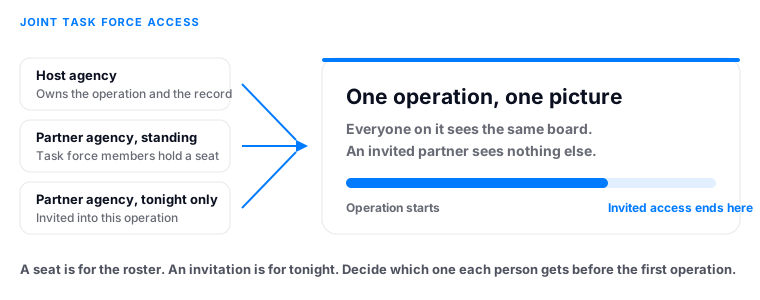
Every task force has two kinds of outside people. The core members, who are on the roster and on every operation. And the partners who show up for one job: the agency whose city you are working in tonight, the probation officer with the file, the analyst who built the target package.
Treat them differently. A core member gets a seat. They hold an account in your system, they are on the roster, they are there next week. A seat is a real seat: that person sees what your own officers see. A one-night partner gets an invitation to this operation and nothing else. When the operation ends, so does their access, and nobody has to remember to turn it off.
The mistake is giving everyone a seat because it is easier in the moment. Six months later you have forty accounts, half of them for people who worked one operation, and no one can say who still should be there. Give a seat only to someone you would trust with what your own officers see. Everyone else is invited per operation, even if they show up every week. Decide the door for each person before they walk through it.
Do this: write the roster down. Two columns. Standing members and the agencies that will show up for single operations. That list is the access policy, whether or not you ever call it one.
2. Scope access to the operation, not the agency
When you add an outside officer to your systems, the default in most tools is agency-wide. They see every incident, every roster, every name. That is far too much for a partner and it is the thing your chief will ask about first.
The right scope for a partner is the operation. A partner invited for tonight sees tonight's operation. They do not see the burglary series patrol is working across town or the personnel list for your whole department. A standing member who holds a seat is a different decision. A seat makes them one of yours, with the view your own officers have. That is a call your chief makes by name, on purpose, not something that happens because an account was the fastest way in. If a standing member should not have that view, keep them on per-operation invitations.
This is also the answer to the question your counsel will ask. An outside officer looking at your criminal justice information is a question for your agency's CJIS policy and your state's systems agency, not something a sergeant decides at a kitchen table. Keep the scope narrow and that conversation is short. Make it agency-wide and it is a long one.
Do this: ask of any tool you use, can I put an outside officer on one operation without putting them in my department? If the honest answer is no, you will end up sharing screenshots instead, and screenshots have no audit trail.
3. Decide when access ends before it starts
Access that never expires is the quiet failure of every shared system. Nobody is assigned to remove people, so nobody does. The investigator who rotated out eighteen months ago still has a working login because taking it away was never anyone's job.
Set the default at the start. For a one-night partner, access ends when the operation ends. For a standing member, access ends when they leave the task force, and someone by name owns that removal. Not "the admin." A person. NIST’s security control catalog asks for the same thing: assigned account managers who are told when a user leaves or transfers.
If the operation runs long, extending access is a decision someone makes on purpose. That is better than access that quietly lasts forever.
Do this: name the person who removes people. Put it in the task force agreement next to the person who approves overtime.
4. Know whose record it is
A task force operation produces a record. Assignments, timeline, who was where, what the picture showed when the decision was made. That record will be requested. By a defense attorney, by a records request, by your own administrative review.
Three things have to be true. The host agency owns the record and controls what it discloses. The record names everyone who was let into the operation, including the partners who were invited in for one night, along with who let them in and when their access ended, so you can answer "who had access to this" with a list instead of a guess. And the partner agency gets what it needs for its own case file without receiving your whole incident.
If your task force takes federal money, your intelligence records may carry additional handling rules. Your counsel decides whether that applies to you. The point here is narrower: whatever rules apply, you can only follow them if you know who the record belongs to and who has seen it.
Do this: before the first operation, agree in writing which agency is the system of record for task force operations. One agency, not a rotation.
5. Get the partner's eyes into the room
The partner agency brings more than people. It brings its own drone, its own cameras, its own surveillance platform. On most task forces that video lives on the partner's phone, and the way it reaches your command post is someone holding the phone up or texting a clip.
That is a shared picture in name only. The command post is making decisions on a picture one agency can see and the others are hearing described over the radio.
The standard worth holding is that whatever the partner is looking at, your commander is looking at too, live, in the same place as your own feeds. Not a phone held up to a monitor, and not a clip that arrives after the decision was already made.
Do this: at the planning meeting, ask each agency what it is bringing that has a camera on it. Then ask how the command post will see it. If the answer is "we will figure it out," you will not.
Where BabbarOps fits
I built BabbarOps around the operation rather than the agency, which is why task forces are a natural fit. In Incident Command, a partner for tonight is invited into one operation, sees that operation alone, and loses access when it ends. A standing member holds a seat on your roster, and a seat is a full one: they work in your system the way your own officers do, so you give it to the people you would trust with that. The host agency keeps the record, the record names every person who was let in, and the agency decides what it discloses. Video is the other half. Live Command brings a partner agency's drone feed into the same place as your own feeds, live, and we set that up with you for the agencies on your task force.
None of that is exotic. It is the five questions above, settled before the operation so the sergeant running it does not have to answer them at 2 a.m.
Put it in the agreement
Most task forces run on a memorandum of understanding. It covers command, overtime, vehicles, evidence, and liability. It almost never covers access to the shared picture, because when most of these agreements were written there was no shared picture to cover.
Add a section. It needs five lines:
- Which agency hosts the operational picture and owns the record.
- Who holds a standing seat and who is invited per operation.
- What an invited partner can see: the operation, not the agency.
- When access ends, and the named person who removes people.
- How partner video reaches the command post live.
Those five lines take an afternoon to agree on. The first operation without them takes longer than that to untangle, and you only find out what you missed when someone asks for the record.
The bottom line
A joint task force is not a bigger version of your own operation. It is several agencies agreeing to work from one picture while keeping their own houses separate. The agreement about who sees what, until when, and whose record it is, is the part that makes that possible. Decide it before the first operation. Everything after is easier.
Split them into two groups. Standing task force members hold a seat in the host agency's system and stay on the roster, which gives them the view the host's own officers have. Partners who join for a single operation are invited into that operation alone, and their access ends when it ends. Decide which door each person gets before the first operation rather than giving everyone a permanent account.
For a partner invited to an operation: the operation, not the agency. They should not see the host agency's other incidents, its personnel list, or unrelated cases. A standing member who is given a seat is treated as one of the host's own, so decide who holds a seat by name. Narrow scope is also what keeps the conversation with your agency's CJIS policy and counsel short.
Agree on one host agency in writing before the first operation. That agency is the system of record, controls what it discloses, and keeps a record that names everyone who was on the operation, including partners invited for one night. Partner agencies receive what they need for their own case files without receiving the host's entire incident.
It should. Most agreements cover command, overtime, vehicles, evidence, and liability but say nothing about the shared picture. Five lines cover it: who hosts the picture and owns the record, who holds a seat and who is invited per operation, what an invited partner can see, when access ends and who removes people, and how partner video reaches the command post live.
If you run or sit on a joint task force and want to see what one operation across several agencies looks like in practice, we can walk you through it with your own roster in mind.
Download the one-page overview
Sukh Bhela is a California police sergeant who has served as a UAS operator, UAS supervisor, and incident commander during critical incidents. His experience leading patrol operations and integrating drone technology into public safety responses led him to found BabbarOps, where he builds tools for live situational awareness and incident command. He writes about policing, drone operations, leadership, and the technology shaping the future of emergency response.
Published in Police1 · Covered by Officer.com · Press
The views expressed here are the author's own, written in his personal capacity. They do not represent, and are not made on behalf of, any law enforcement agency or employer.
This article is general information and not legal advice. Access to criminal justice information, records retention, and intelligence handling requirements vary by state, by agency policy, and by funding source. Confirm current requirements with your agency counsel and your state's CJIS systems agency.