
AI in Incident Command: Cut the Busywork, Not the Call
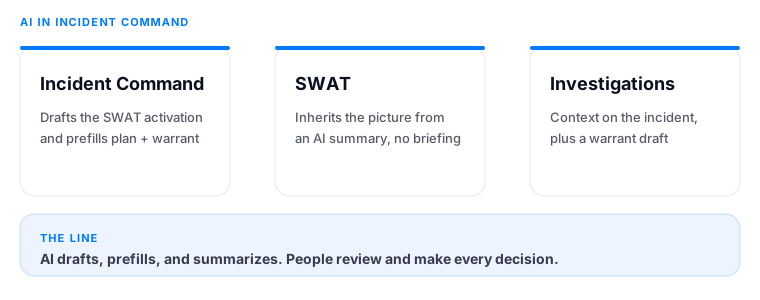
BabbarOps uses AI to remove the administrative load around a critical incident, not the judgment inside it. It drafts the SWAT activation, prefills the operational plan and warrant details from the incident record, and gives SWAT and investigations an instant summary so they inherit the picture without pulling anyone off the radio. AI drafts, prefills, and summarizes. The people in command review everything and make every decision.
Most of what gets sold as AI for law enforcement is aimed at the wrong place. The promise is usually that the software will decide something for you. On a live incident, that is exactly backwards. The person running the call does not need a machine making decisions. They need the busywork around the decision to disappear so they can think.
That is the whole design principle for how BabbarOps uses AI in incident command: cut the administrative load, not the judgment. The test for any of it is simple. Does it lower the load on the person making the call, or add one more screen to watch? Here is where it earns its place, role by role.
For the incident commander: less transcribing, more deciding
When a call grows into a real incident, the person running it is suddenly buried in administrative work at the exact moment they can least afford it: notifications to make, a plan to stand up, paperwork to start, all while the radio and the phone will not stop. That is when an incident commander stops thinking and starts transcribing, and at that scale a person cannot do both.
AI takes the transcribing. It drafts the activation, for example the call to the watch commander to stand up SWAT, from what is already happening on the incident. It prefills the operational plan and the warrant details from the information patrol has already captured, instead of making someone retype it under pressure. The incident commander reads it, fixes anything that is off, and decides. The decision stays with the person. The keyboarding goes away.
For SWAT: inherit the picture, skip the cold briefing
The most expensive moment in a tactical activation is the handoff. A team rolls up and asks for a briefing from the top, so someone who was running the scene has to stop and walk through all of it again, out loud, while the perimeter sits.
AI closes that gap. It generates a current summary of the incident so the arriving team inherits the operational picture on the way in, who is inside, where containment sits, what has changed, without pulling anyone off the radio to brief them. SWAT gets oriented from the record, not from a person's memory, and the people on scene keep working.
For investigations: context without a phone call, and a warrant draft
Detectives usually arrive into an incident cold, reconstructing days later what patrol already knew, by calling around. The same summary that orients SWAT orients investigations: the context of a live or planned operation, available without interrupting anyone who is busy running it.
For the paperwork that the incident demands, AI drafts the warrant from the incident record as a starting point, for a live operation or a planned one. It assembles what is already known into a first draft so the detective is editing instead of starting from a blank page. The detective reviews it, corrects it, and owns it, and a judge reviews and signs it. AI speeds the drafting. It does not make the legal call, and it does not file anything.
The line we do not cross: AI suggests, people decide
Everything above is the same move: AI handles the load, a person makes the decision. That line is deliberate and it does not move.
- AI does not activate a team. It drafts the notification; the commander sends it.
- AI does not make a use-of-force decision. That is never a software output.
- AI does not write the final warrant or file it. It drafts; the detective and the court decide.
- Everything it produces is a draft a person reviews, edits, and signs off on. Nothing executes on its own.
That is not a limitation we apologize for. It is the point. The agencies that get the most out of AI are the ones that use it to simplify the work for the person making the call, not to take the call away from them.
No. AI drafts, prefills, and summarizes; the people in command review and decide. It never activates a team, makes a use-of-force decision, or files a warrant on its own. Everything it produces is a draft a person reviews and signs off on.
It handles the administrative load. It drafts the activation notification, such as the call to the watch commander to stand up SWAT, and prefills the operational plan and warrant details from the incident record already captured, so the commander can focus on running the scene instead of transcribing.
Yes. AI generates a current summary of the incident so an arriving team inherits the operational picture, who is inside, where containment sits, what has changed, without pulling someone off the radio to brief them. SWAT and investigations get oriented from the record, not from memory.
It drafts a warrant from the incident record as a starting point, for a live or planned operation, so the detective edits instead of starting from a blank page. The detective reviews, corrects, and owns the document, and a judge reviews and signs it. AI speeds the drafting; it does not make legal determinations.
Want to see where AI fits in your incident workflow, and where it deliberately doesn't? We will walk it with your command staff.
Sukh Bhela is a California police sergeant who has served as a UAS operator, UAS supervisor, and incident commander during critical incidents. His experience leading patrol operations and integrating drone technology into public safety responses led him to found BabbarOps, where he builds tools for live situational awareness and incident command. He writes about policing, drone operations, leadership, and the technology shaping the future of emergency response.
The views expressed here are the author's own, written in his personal capacity. They do not represent, and are not made on behalf of, any law enforcement agency or employer.
This article describes how BabbarOps applies AI to assist incident workflow. AI outputs are drafts and summaries that a person reviews, edits, and approves; the platform does not make activation, use-of-force, or legal determinations, and warrant drafts are starting points reviewed by the detective and the court. Capabilities are implemented in coordination with each agency's policy and legal authorities. BabbarOps is an independent commercial product and is not affiliated with, endorsed by, or operated on behalf of any law enforcement agency.