
How BabbarOps Secures Live Drone Video
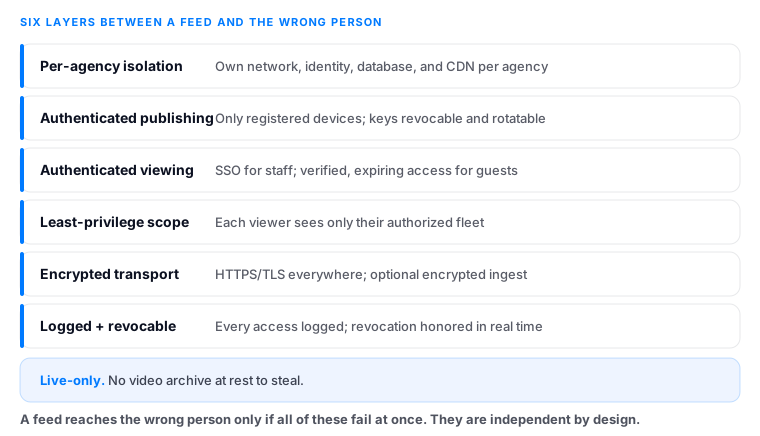
A live feed on BabbarOps reaches an unauthorized person only if several independent layers fail at once: per-agency infrastructure isolation, authenticated publishing, authenticated viewing, least-privilege scope, encrypted transport, and a logged, revocable access model. Only devices you registered can publish, only people you authenticated can watch, each sees only their authorized slice for only as long as you allow, and the platform stores no video at rest.
Agencies ask a fair question before they put a live feed on anyone's screen: who can see it, and how do you know? This is the architecture behind the answer for Live Command, the part underneath the compliance conversation. Our CJIS articles cover why a live-only design carries a lighter CJIS compliance burden. This one covers how the platform keeps a feed visible only to the people you authorize.
Put plainly: only devices you registered can publish, only people you authenticated can watch, each person sees only their authorized slice for only as long as you allow, every byte travels encrypted, every agency is walled off from every other, and every access is logged. A feed reaches the wrong person only if several independent layers fail at once.
Each agency is its own island
The security property agencies most often forget to ask about: are you in a shared database with everyone else, separated only by a customer ID column? On BabbarOps, no. Every agency runs on its own dedicated, isolated cloud infrastructure: its own private network, its own identity directory, its own database, its own content-delivery distribution, and its own domain.
There is no application path from one agency to another, because the resources are genuinely separate, not logically partitioned. Every authenticated request also carries a signed agency identifier, and the server rejects any credential whose agency identity does not match the instance it is presented to, so a token minted for one agency is inert at another. Your feeds, your users, and your audit history sit in infrastructure that is yours alone. A multi-tenant leak is not a failure mode that exists here, because the tenants do not share the thing that would leak.
Nothing publishes without being authenticated first
A drone, encoder, or phone cannot push video at the platform and have it appear. Every publish attempt is authorized before a single frame is accepted.
- Registered keys. Each device is issued a unique, rotatable stream key, validated in real time against the agency's registry on connect. Unknown or malformed keys are rejected. There is no anonymous publishing.
- Deactivation. A device that has been turned off is rejected even if it still holds its old key.
- Protocol binding. A key is tied to its expected ingest path, so a leaked key cannot be repurposed onto another transport.
- Anti-hijack. If a second device tries to publish to a key that is already live, the duplicate is rejected. A legitimate, on-air feed cannot be bumped off the air by an impostor or a misconfigured encoder.
- Instant rotation. Rotating a key immediately invalidates the old one, so a lost or exposed key stops working on its next attempt.
Nothing is watched without an authenticated identity
Viewing is gated on every request, not just at login: listing feeds, loading a playlist, opening a stream. There are two kinds of legitimate viewer, and both are authenticated.
Your staff sign in through your agency's identity provider, single sign-on or email and password backed by a managed identity service. A successful sign-in yields a server-side session carried in a secure, HTTP-only cookie that scripts cannot read and that only travels over encrypted connections. Every request re-checks the session and the user's role. Administrators manage users, devices, and fleets. Operators manage and view devices and feeds. Viewers watch but change nothing. These boundaries are enforced on the server, per endpoint, not hidden in the interface.
Invited guests, like mutual-aid partners or one stakeholder for one incident, never get a standing account. They get a time-limited invitation, verify with a one-time code, and receive a scoped, expiring token. It expires automatically after a window you choose, measured in hours. It is scope-limited to the fleet they were invited to. And it can be revoked instantly: the server re-verifies on every request that the invitation is still active, so a revoked guest loses access on their next call, not whenever the token would eventually have lapsed.
People see only their slice
Authorization is need-to-know, enforced at the data layer. Feeds are organized into fleets, and access is granted per fleet. The server filters the feed list down to the caller's authorized scope before the response ever leaves the building, so out-of-scope feeds are never sent, not merely hidden in the interface. Nobody, staff or guest, receives more than their role and scope allow.
Everything travels encrypted
- All browser-facing traffic, the dashboard, every API, and the live video playlists and segments, is served over HTTPS/TLS, with sessions on secure, HTTP-only cookies.
- Live video is delivered through a global content-delivery edge over TLS, so each viewer pulls segments from a nearby node rather than from the origin.
- For the field uplink, the platform supports encrypted ingest (TLS-based RTMPS and SRT) for devices and networks that require the uplink itself to be protected end to end.
Live Command retains no video, so there is no stored footage at rest to steal
Live Command is live-only. Video is transcoded and delivered in flight; the platform is not a video archive and does not write your feeds to long-term storage. The single most valuable target in most video systems, the retained library, does not exist here. Your existing evidence system stays the system of record.
Every access is accountable
Prevention is half of security. Provability is the other half. BabbarOps records an audit trail of security-relevant events: sign-ins, guest invitations and revocations, device authorizations and rejections, and administrative changes. Records are committed to durable storage synchronously, so a restart never loses them, and can be written to write-once, tamper-evident storage for agencies that require an immutable log. You can answer who watched what, and when, after the fact, with confidence.
The layers, together
| Layer | What stops an unauthorized viewer |
|---|---|
| Infrastructure | Each agency on its own isolated network, identity directory, database, and CDN |
| Identity | SSO for staff; one-time code plus expiring, revocable token for guests; agency-bound credentials |
| Publishing | Per-device authenticated keys; deactivation, protocol binding, anti-hijack, instant rotation |
| Authorization | Per-request role checks and fleet-scope filtering at the data layer; revocation honored in real time |
| Transport | HTTPS/TLS everywhere; secure HTTP-only cookies; optional encrypted ingest |
| Data at rest | Live-only, no video archive to compromise |
| Accountability | Durable, optionally immutable audit log of every security event |
A feed reaches the wrong person only if all of these fail at once. They are independent by design.
Questions worth asking any live-video vendor
Ask these of anyone, including us:
- Is each agency genuinely isolated, or separated only by a database column?
- Can a device publish without being authenticated, and what happens to a leaked or rotated key?
- Is viewing authorized on every request or only at login, and how fast does revocation take effect?
- Can a guest ever see a feed outside their assigned scope?
- Are the field uplink and the viewer delivery both encrypted?
- Does the platform retain video, and if so, who secures the archive?
- Can you produce a record of who viewed what, and when?
We built BabbarOps so our answers to all seven hold up to scrutiny.
Sources
The external references behind the compliance framing above:
- FBI, Criminal Justice Information Services Division — the CJIS Security Policy. Most of its heaviest requirements attach to stored criminal justice information, which is why a live-only video path carries less of it.
- AWS GovCloud (US) — the isolated AWS regions used for the controlled Incident Command deployment.
No. There is no view link that works without an identity behind it. Staff authenticate through the agency's identity provider; invited guests verify with a one-time code and receive a scoped, expiring, revocable token. Viewing is authorized on every request, not just at login.
Yes. Every agency runs on its own dedicated infrastructure: its own private network, identity directory, database, content delivery, and domain. Credentials are agency-bound, so a token for one agency is rejected at another. Agencies do not share the resources that would leak.
No. Live Command is live-only. Video is transcoded and delivered in flight and is not written to a long-term archive, so there is no retained video library to compromise. The agency's existing evidence system remains the system of record.
Immediately. Because the server re-verifies on every request that an invitation is still active, a revoked guest loses access on their next call, not whenever the token would have expired. A lost or exposed device key can be rotated and stops working on its next attempt.
Vetting a live-video platform for your agency? Bring these questions to a working session and we will walk the architecture with your IT and policy staff.
This article describes BabbarOps Live Command's security architecture as implemented today and is provided for general information, not as a warranty or a substitute for your agency's own security review. Specific configurations and compliance obligations are implemented in coordination with each agency's IT and policy authorities. BabbarOps is an independent commercial product and is not affiliated with, endorsed by, or operated on behalf of any law enforcement agency.